
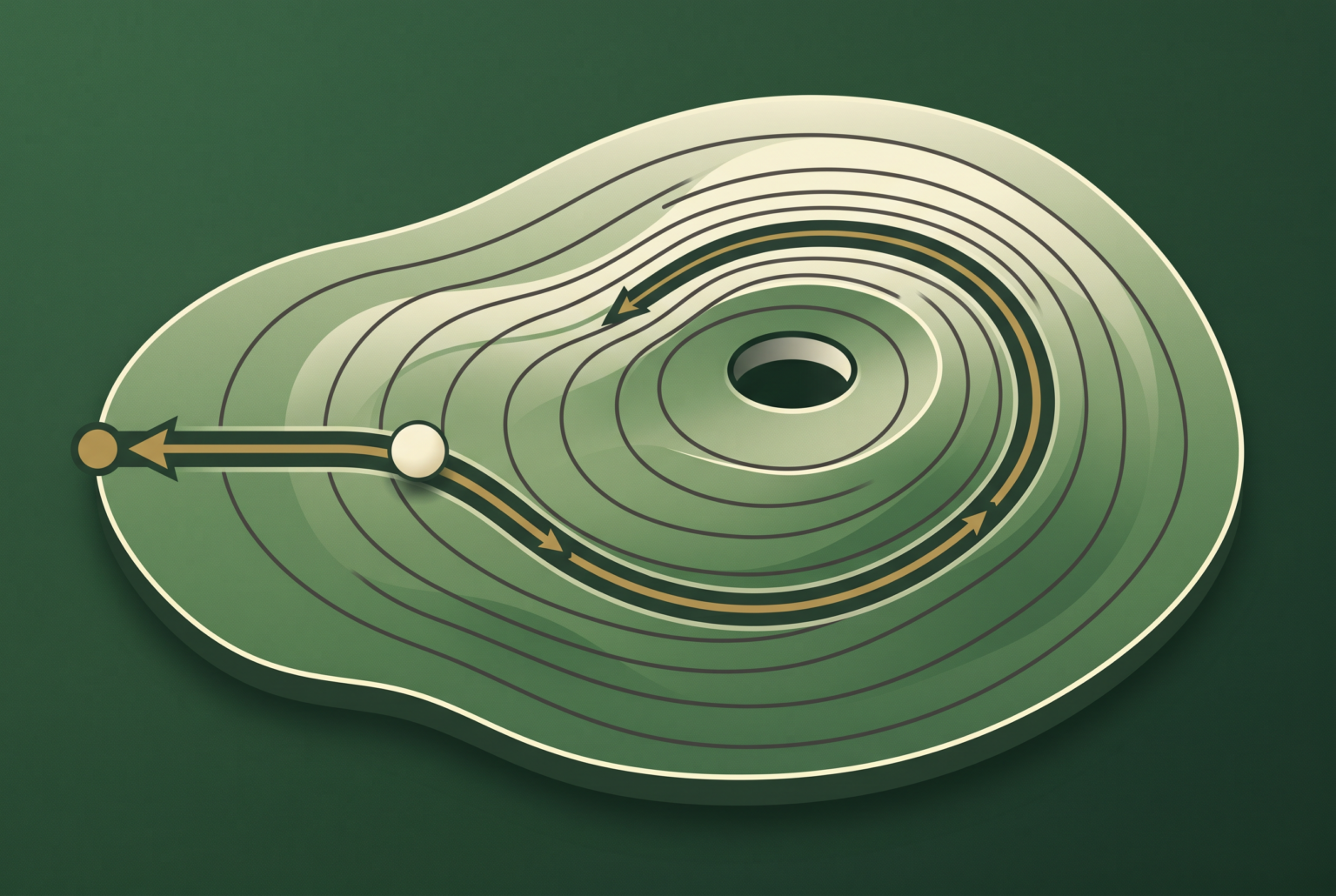
See the green; then let the stroke happen.
Learn slopes and speed with fewer assumptions and more repetition.
Read the green in stages
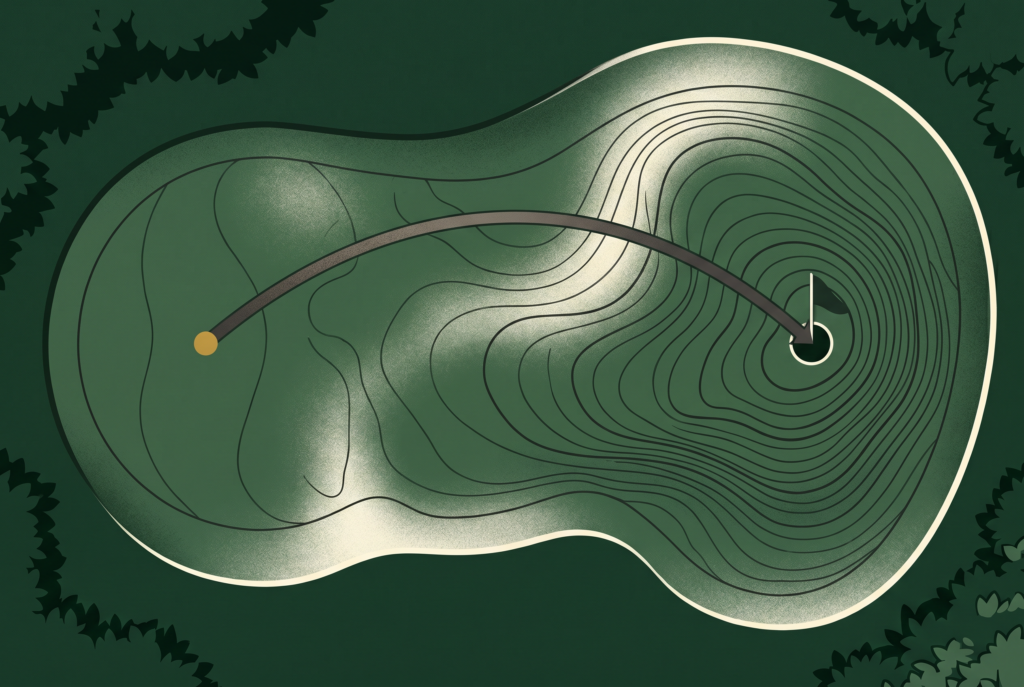
- Start with the line you intend to roll the ball on. Pick a target point a few inches inside the hole on your chosen line.
- From behind the ball, read the slope as you address. Note which way the grain shifts your aim and how the ball would break toward the hole.
- Step off the ball and take a second look from about 6–8 feet away. A wider vantage often clarifies whether the slope bends more than you first sensed.
- Confirm your line by aligning the putter face with the chosen target point and then rehearse a smooth, deliberate stroke before you roll.
- Keep to a simple rule: identify the line first, then judge the speed. Don’t chase a perfect read in one glance.
Pro Tip. If the slope seems complex, start with a straight forward line and adjust in small increments. A staged read reduces overthinking and builds consistency.
How to judge slope without overthinking
- Use a simple apex reference: imagine a small point a few inches uphill of the hole in the direction the ball must travel. Your stroke should aim to pass slightly outside that point.
- Roughly estimate break in thirds: a gentle slope (less than 2 degrees) might move the ball a few inches; a steeper break (3–4 degrees) can move it several inches or more. Use this as a guiding scale rather than a precise angle.
- Test the line with practice strokes. If you can feel the line on your putter face as you swing, you’re more likely to commit to the read.
- Trust a repeatable method: pick a single reference line, then stick to it for the round. Consistency is the aim, not perfection on every putt.
Pro Tip. Rehearse one-second strokes on flat practice mats to sense how small changes in face alignment alter the line. Subtle adjustments yield big dividends on the green.
Speed clues: fringe, length, and firmness
- Fringe interaction matters. A ball rolling through the fringe loses a portion of speed before it reaches the dance floor of the green — plan for a slower, more deliberate pace if you feel resistance.
- Length of the putt dictates tempo. Short putts (3–6 feet) benefit from a compact, pendulum-like motion. Medium length (6–12 feet) asks for a controlled tempo with a little more shoulder rotation. Longer putts (12–20 feet) require a steadier rhythm and a longer follow-through to maintain line.
- Firmness of the green matters too. On soft greens, your ball will stop quicker; on firmer greens, you may need a touch more pace to avoid a short finish.
Pro Tip. If the ball stops too quickly, ease off your tempo slightly and let the stroke travel a touch longer. If it’s racing past, shorten the backswing and commit to a cleaner follow-through.
Putting from different distances: what changes
- 3–4 feet: aim for a smooth, quiet stroke with minimal wrist action. Focus on keeping your eyes on the target and making a clean strike.
- 6–8 feet: use a slightly longer stroke and a relaxed grip pressure. Your body should feel like a natural pendulum — hips and shoulders rotating together.
- 10–15 feet: steadiness matters most. Keep the eyes level, maintain tempo, and let the putter head travel on a straighter path. Visualise a narrow lane from ball to hole and resist the urge to swing harder to “make” the ball drop.
- Alignment and setup don’t change dramatically with distance, but your feel for pace does. Practise the same stances and let the length of your stroke adjust to distance rather than your posture.
Pro Tip. Establish a consistent pre-putt routine that includes alignment checks, a breath cue, and a two-step look at your line. Repetition here beats last-minute guesswork.
Confidence routines: stare-softly technique
- Pre-putt ritual: address the ball with a comfortable, balanced stance, take a breath, and take one short look at your line from behind the ball. Then soften your gaze — not a hard stare, but a relaxed focus along the intended line.
- As you proceed to stroke, keep eyes level with the line, and imagine the ball tracing a curved path toward the hole without lifting your head prematurely.
- After you finish the stroke, quickly assess the line by watching the ball finish and then reset for the next read.
Pro Tip. Stare-softly for a brief moment without forcing focus. The aim is to reduce tension and improve alignment consistency, not to chase perfect vision every time.
Drill: line confirmation without gimmicks
- Gate drill (two-tee version): place two tees on either side of your ball along your intended line, spaced about the width of a golf glove apart. The objective is to stroke the ball without touching either tee, confirming your line and stroke path.
- Progression: begin with short putts (3–6 feet) and gradually move to longer ones (8–15 feet). If you clip a tee, adjust your aim slightly and reset.
- If you lack tees, use a string or a couple of clubs laid parallel to your line to simulate a gate.
Why it helps: it trains your eye to align with the actual line, while your body learns a repeatable stroke path.
Course examples for first-timers
- Practice greens on straightforward, lightly contoured layouts are ideal for starting out. Choose sections with a mix of 3–8 foot putts to reinforce reading and pace control.
- Use a small sampler: a flat area for speed, a gentle slope for break, and a couple of longer straights to test rhythm.
- When moving to on-course greens, target areas near the hole that reward a confident read over a safe but timid line. Remember the goal is repeatable reads and steady speed, not heroic greenside heroics.
When to accept a makeable miss
- For a 3–4 foot putt with a moderate break, if the read feels uncertain, commit to a comfortable line that keeps the ball near the hole rather than chasing a heroic line.
- If you sense a right-to-left break but your read is uncertain, you may favour a line that leaves you a short par-saving putt rather than ending up with a risky conversion.
- The aim is a lower number of one-putts than spectacular but risky makes. A makeable miss is often a smarter play when the alternate is a putt with high chances of two-putt harm.
What’s next
- Building a practice plan for greens reading.