

A yardage you trust beats a swing you chase.
Stop guessing—build a yardage system for scoring, not ego.
How distance gaps form (and why beginners struggle)
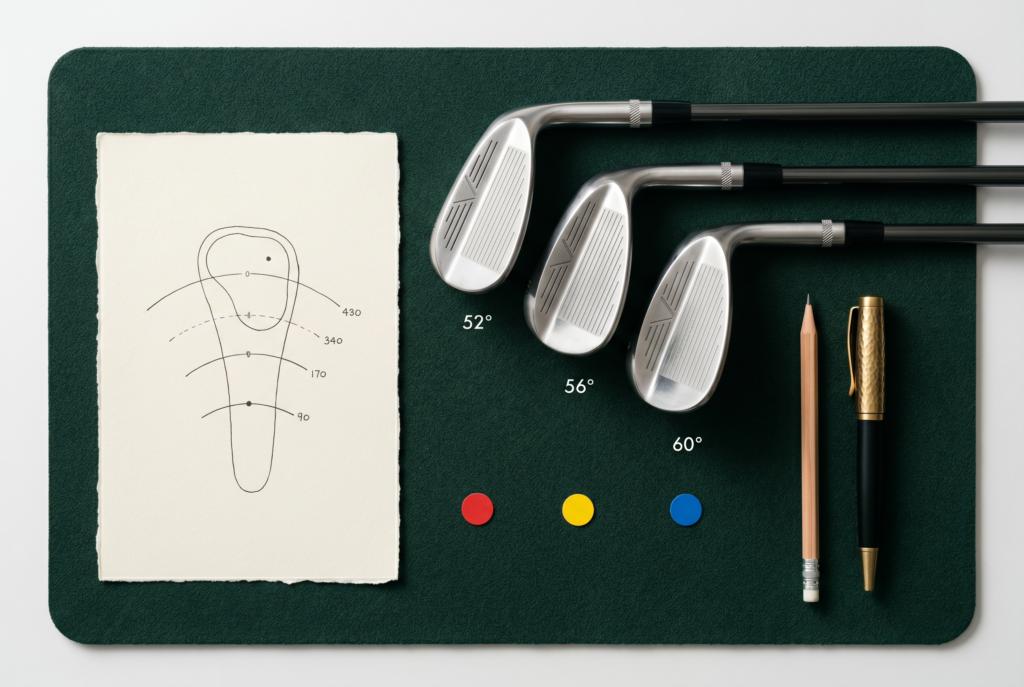
Distance gaps arise from how the ball travels and how the ground behaves after it lands. For beginners, gaps widen because contact is inconsistent, launch and trajectory vary shot to shot, and ground firmness changes how far a ball rolls after landing. Add wind, slope, and the lie of the ground, and the same club can feel wildly unreliable from one day to the next.
Key factors at play:
- Carry versus roll: some days the ball flights higher and stops quickly; other days it runs out on a firm fairway.
- Launch and height: modest changes in swing speed or angle can shift carry a lot, even with the same club.
- Conditions: headwinds shorten carry, tailwinds can exaggerate roll; soft surfaces reduce roll but can also kill distance on a steep downhill lie.
- Technique consistency: tempo, ball position, and finger grip influence expected distance more than most players realise.
Pro Tip. In your practice, track not just how far your ball goes but how often you hit the intended landing zone. A reliable landing area is the seed of a trustworthy yardage system.
The “three-number” method for each club
For each club, capture three concrete numbers during normal practice shots. Write them down and build your yardage map from them.
What to record for every club:
- Carry distance: how far the ball travels in the air before it lands.
- Total distance: carry plus roll on a typical fairway.
- Dispersion or accuracy: the width of your misses left and right across a short sequence of shots (or the maximum deviation from your intended line).
How to implement:
- Use a rangefinder or marker targets on the range to gauge carry and total distances under typical conditions.
- Hit 5–10 shots per club to get a representative sample.
- Note the wind and lie conditions for each shot so you can separate weather effects from pure club performance.
Sample entry structure (blank to fill in):
- Club: 7-iron
- Carry: _____ yards
- Total: _____ yards
- Dispersion: _____ yards left/right
- Wind/lie notes: ____________________
- Pro Tip: Treat the three-number method as a living document. Return to it every few weeks, re-check on a calmer day, and adjust as your swing and comfort improve.
Range to course: accounting for wind and lies
Ranging practice to real-course play means translating range numbers to on-course reality. Start from your baseline, then adjust for wind, slope, and the lie.
Guiding steps:
- Wind: headwinds shorten carry; tailwinds lengthen it. In practice, anticipate modest adjustments rather than precise numbers.
- Lies: uphill lies shorten distance and lower ball speed; downhill lies can unexpectedly add distance (and spin variation).
- Ground and slope: firm fairways promote more roll; soft fairways shorten total distance.
A practical framework:
- Establish a baseline from your three-number data for each club.
- On a windy day or a slopey hole, treat it as a one- or two-club adjustment. If the wind is noticeable, move one club shorter for carry and anticipate less roll if the turf is soft.
- When lies are unfavourable (heavy rough, toe-up/bowed lie), plan to hit higher shots with more height and less rollout, or choose a layup to a safer distance.
Pro Tip. When in doubt on a windy or uncertain lie, aim for a safe landing zone within your reliable wedge range rather than green-lighting a risky shot. A well-chosen layup converts long carries into reliable scoring opportunities.
Wedge yardage mapping: scoring distances first
Wedges are about proximity to the hole, not raw distance. Build a map around scoring distances—where you can land the ball close and leave yourself a realistic next shot.
Equipment note: typical lofts (approximate guidance)
- Pitching wedge: 46–48 degrees
- Gap wedge: 50–54 degrees
- Sand wedge: 54–56 degrees
- Lob wedge: 58–60 degrees (optional)
What to map:
- Two or three practical landing distances from around the green where you feel confident in control.
- Height control: practice both high flop-like shots and lower, running chips to suit various green speeds.
- Proximity targets: aim to land within 6–12 feet from the hole on your chosen targets, with the rest becoming practice for improving feel.
How to build it:
- Start with your standard pitching wedge and a second club in the mid-range (gap wedge or sand wedge).
- Choose two landing distances per club that you can repeat with good contact.
- Practice transitions: mid-range chips that land softly, and lower chips that run to the hole.
Pro Tip. Don’t chase distance on wedges. Your scoring success comes from predictable height, consistent landings, and controlled roll to the heart of the target zone.
Shot types: carries vs total distance basics
Understanding carry versus total distance helps you tailor shots to greens, hazards, and run-outs.
Key ideas:
- Approach shots to greens: prioritise carry and landing control to shorten the ball’s role and ensure it stops where you intend.
- Firm fairways: allow for extra roll with lower, controlled shots when a precise landing is needed.
- Short game: emphasise height and spin on higher lofted wedges to keep the ball in the air longer and land softly.
For beginners, the focus should be on controlling carry height for the approach and using guided run-out when the flight is too high or too low for the landing zone.
Pro Tip. Practise with one club at a time for both high and low trajectories. Being able to switch between height profiles on demand is a powerful reliability builder.
The layup mindset: making the smart decision
Smart decision making under pressure matters more than heroic swings.
Decision framework:
- Before the shot, assess the landing zone and your next shot distance. Is your next club within your reliable wedge range?
- If the flag is guarded by a hazard or the green is tucked behind a difficult slope, consider a layup to a safer, reachable distance rather than forcing a miracle shot.
- Choose a target that sits squarely inside your mapped distances, with a clear path to the next shot.
Practical approach:
- Treat every hole as two plays: the layup distance and the approach distance. If the approach requires more risk than you’re comfortable with, pick the safer target.
- Use your three-number map to decide which club and shot type give you the best chance for a birdie putt or a solid par.
Practice reps that refine accuracy, not max distance
Your aim is consistency, not heroic distances. Focus practice on accuracy and repeatable contact.
Recommended drills:
- Target-focused reps: pick two landing zones and hit five balls to each, aiming for the same distance with consistent height.
- Height control drill: practice high, mid, and low shots with the same club to build feel for changing trajectories.
- Alignment work: place two sticks to mimic fairway lines and ensure your body alignment and club path point at the intended target.
- Two-ball ladder: start with a shorter target, then push your distance slightly while keeping the same tempo and contact quality.
Drill cadence:
- 3 sets of 5 shots per club per practice block, alternating between height and landings.
- Finish with one-pressure shot to a chosen target to simulate on-course decision making.
Pro Tip. Rehearse both the landing zone and the position of the ball in your stance. Ball position and posture drive release and contact quality more than raw swing speed.
Recording data simply: one notebook system
Keep your data in one place with a simple, durable notebook. A single page per club keeps you honest and focused.
Notebook layout (per club):
- Club name
- Baseline carry distance (practice)
- Baseline total distance (practice)
- Baseline dispersion (practice)
- Recent weather and lie notes
- On-course observations (which holes or situations felt most controllable)
Update cadence:
- Review every 2–3 weeks or after a round with notable wind or lie changes.
- If a number shifts by more than a couple of yards, note it and adjust your yardage map accordingly.
This one-notebook system gives you a clean reference for making on-course decisions and tracking improvement without drowning in data.
What’s next
Course management basics for beginners – a practical companion to the yardage system you’ve started here. It will help you translate your numbers into smarter choices on every hole, from tee to green.