

A lighter grip often makes a truer strike.
Learn how to hold the club so the face behaves, even when you’re learning.
Why grip pressure controls consistency
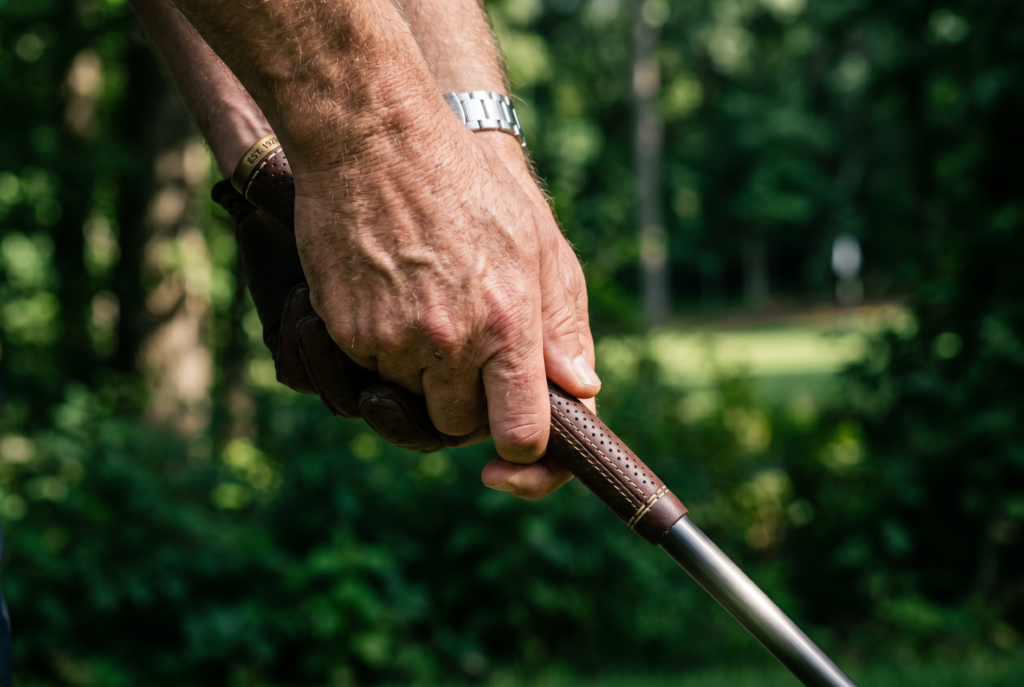
The grip is your only direct line to the club during the swing. If the hands grip too tightly, tension travels up the forearms and into the wrists, limiting hinge and delaying the release. If the grip is too loose, the clubface can wander through impact because the hands lose control of the club’s orientation. The aim is a light, quiet grip that lets the wrists respond naturally to the swing. With that equilibrium, the face stays recognisable to your intention, and contact becomes more repeatable.
Tips to cultivate consistency:
- Keep the grip pressure in a “soft yet ready” zone. Think comfortable enough to feel the club in your fingers, not in your knuckles.
- Let the wrists hinge and release with the flow of the swing, not by brute arm effort.
- Let your base posture do the stabilising work; the grip should be the bridge, not the source of tension.
Pro Tip. Use a slightly relaxed grip when you practise tempo drills and you’ll notice the clubface behaves more predictably through impact.
How tight feels become bad impact
When you squeeze too hard, the hands lose sensitivity to the club’s micro-movements. This often produces:
- Reduced lag and a stiffer takeaway, which can push the clubface closed or open at impact.
- Inconsistent contact as the clubface twists relative to the swing arc.
- Ball flight that veers unpredictably, masking your path and face control.
The cure is not more strength, but better timing and awareness. The goal is to feel the club in your fingers, not clamp it in your palms.
A simple pressure test you can repeat
Use a 7-iron and run through three simple levels on each of three practice shots.
- Level 1: Light grip (about 2/10). Stand tall, swing to half-speed, and focus on quiet hands throughout. Note how the clubface responds at impact.
- Level 2: Moderate grip (about 5/10). Repeat three half-speed swings. Compare the sensation of the face staying square versus twisting.
- Level 3: Firm grip (about 7/10). Do three half-speed swings again and observe any excess tension or face inconsistency.
Repeat this test weekly with the same tempo. The aim is to notice that you can keep the clubface stable with the lighter grip and still produce solid contact when you need a little more firmness, without turning into muscle tension.
Pro Tip. Keep a tactile cue at the base of your thumb. If you feel you’re squeezing the grip pad against the handle, you’re too tight. Relax, recheck your posture, and restart with Level 1.
Neutral vs strong vs weak: what changes
Grip strength shifts the way the clubface behaves and, in turn, the ball flight and path.
- Neutral grip
- Face at address looks square to your target line; feel is balanced.
- Path tends to stay on plane, which aids straighter shots when the swing is within the basic tempo.
- Ball flights are the most predictable for beginners.
- Strong grip
- Clubface tends to close a little more through impact, which can promote a draw or a hook if the swing path isn’t controlled.
- Some players find it easier to produce a low, penetrating draw from inside, but it can magnify error if timing slips.
- Weak grip
- Clubface tends to stay open through impact, increasing the likelihood of a fade or push.
- Can help with high, looping shots for those who open the face excessively, but consistency often suffers for beginners.
What changes most in practice is how much room you have to let the face react to the swing. Neutral is usually the best starting point for learners.
Hand-to-club connection: the ‘quiet wrist’ cue
The phrase “quiet wrist” refers to keeping the lead wrist from excessive flex or collapse during the swing, allowing the club to stay on its natural arc and release squarely at impact.
- Start with a light grip and a relaxed lead wrist in the address position.
- In takeaway, let the wrist hinge gradually rather than snapping or flipping.
- At impact, aim for the feeling of timing the release with your body rather than forcing the hands to rotate rapidly.
Pro Tip. Imagine you are balancing a fragile egg in the valley of your lead hand. If you grip too hard, the egg cracks; if you hold too loosely, the egg rolls away. The right grip lets the egg stay intact through impact.
Beginner fixes for hooks, slices, and pushes
Hook
- Likely cause: a grip leaning toward strong and a closing face at impact with a inside-out path.
- Fix: move toward a neutral grip, reconfirm alignment, practise a slow takeaway that keeps wrists quiet, and ensure the face is square at address.
Slice
- Likely cause: a grip that’s too weak or an open face at impact with an outside-to-in path.
- Fix: nudge toward neutral, feel a slightly stronger grip to help square the face, and address ball position so you’re not leaning away from the target.
Push
- Likely cause: path too far right with little resistance from the left side of your body.
- Fix: adjust alignment to the target line, keep the head steady, and practise with a more inside-out swing path; use a slightly forward ball position to encourage a more central strike.
In all cases, return to a neutral grip as your baseline before adding complicated swing thoughts. Small, progressive changes beat big leaps that destabilise the ball flight.
How to practice grip without overthinking
- Start with slow, controlled half-swings focusing on grip pressure rather than power.
- Use a mirror or a trusted coach to confirm your hands stay central on the grip and the wrists remain quiet through the backswing.
- Build a short, repeatable routine: address, grip check, pause, swing at half-speed, check impact, reset.
- Keep a simple log: note the level of grip pressure (light, medium, firm) and the resulting ball flight. Look for the pattern where neutral produces the most consistent results.
Drill ideas you can import into your practice:
- The pressure ladder: three levels as described in the pressure test, repeated with the same posture and tempo.
- The quiet-wrist progression: from half-speed takeaways to slow release, focusing on keeping the lead wrist strong and steady through impact.
What to ask your coach in one sentence
What would you focus on to keep my grip pressure consistent and my clubface square through impact while I learn?
What’s next
- Mastering impact by clubface control and tempo: a practical follow-up to build repeatable contact and steadier results.