
Track the signal, not the noise.
A disciplined system for feedback—so you improve with every session.
The 3 categories to record
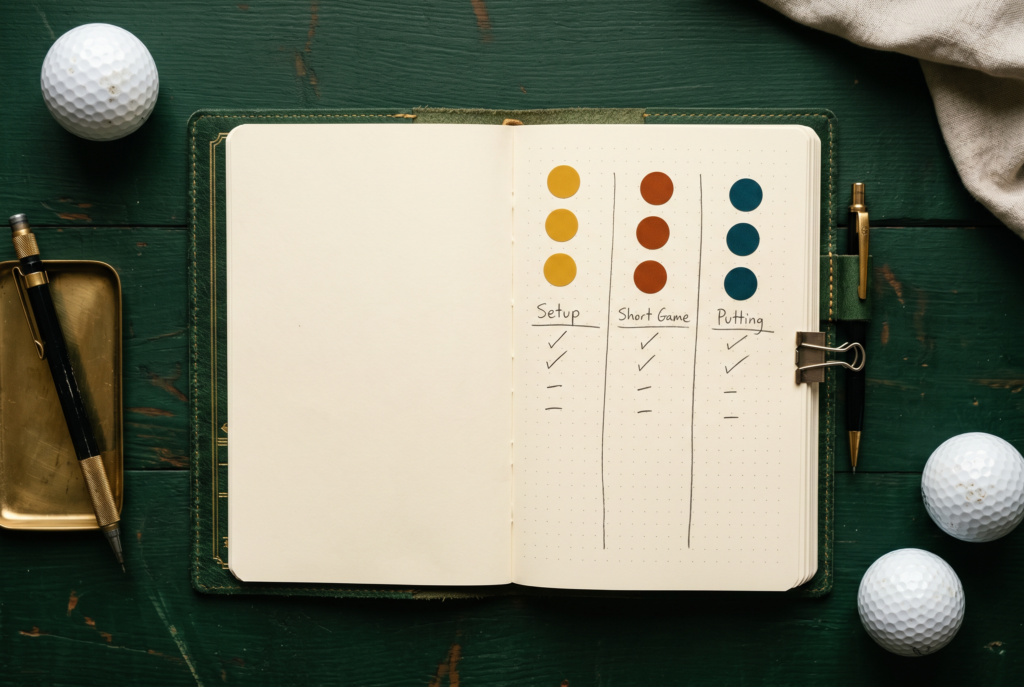
Begin with a lean, repeatable framework. Your notebook should capture three interlinked lenses: Input, Process and Outcome.
- Input (technique): note what you feel in the swing—tempo, timing, grip pressure, and where the club meets the ball (centre contact versus off-centre).
- Process (set-up and routine): alignment, ball position, weight stance, and your pre-shot routine.
- Outcome (ball flight and distance): start line, curvature, and how far the ball actually travels.
Template idea (one line per session works well): Date | Club | Target | Contact quality | Ball flight | Distance vs target | Feel/Tempo (1–5) | Next plan
Pro Tip. keep the fields to 3–5 items per session. Too much data dulls the signal and slows your progress.
Strike quality vs outcome
A solid strike does not guarantee the desired result. You might strike the ball well and still miss due to wind, slope, or distance misjudgement. Treat strike quality and outcome as related but distinct data points.
- Rate strike quality on a simple 1–5 scale (1 = poor contact, 5 = clean, solid contact).
- Record the outcome separately: start line, shape, and distance relative to target.
- Look for patterns: good contact but errant line suggests alignment or face control needs attention; clean contact with odd distance hints at tempo or weight transfer.
If you see improving strike quality without commensurate results, push for a small adjustment—perhaps grip pressure or sequencing—before you chase distance.
Pro Tip. use the same scale for both long and short game. Consistency in rating makes cross-session comparisons meaningful.
Simple scoring for short game reps
Short game is the quickest path to real-score improvements. A compact scoring system keeps your mind clear and your practice purposeful.
- Proximity score for chips and pitches (per rep):
- Within 1 metre: 3 points
- 1–2 metres: 2 points
- 2–3 metres: 1 point
- Beyond 3 metres: 0 points
- Up-and-down bonus: if you hole out within two strokes, add 2 points.
- Session target: aim for a weekly total that trends upward by 10–15 per cent as your confidence grows.
Track a running average across sessions, not a single round. The trend reveals your progress more reliably than any single result.
Putting stats that actually transfer
Putting practice can feel rewarding yet fail to translate to greenside performance if you chase the wrong metrics. Focus on transferable numbers that reflect touch and distance control.
- Make percentage from key distances:
- 3 feet (0.9 m), 6 feet (1.8 m), and 9 feet (2.7 m)
- Two-putt percentage from practice greens, and the rate of up-and-down when you miss the first putt
- Distance-control quality for lag putts: rate attempts that land within a short, predictable corridor around your target
Why these metrics work: they mirror on-course tasks, reward precision, and reward the ability to recover when a first putt misses.
How to spot patterns in your notes
Pattern recognition turns data into direction. Build a simple loop: observe, hypothesise, test, review.
- Tag entries with a few consistent keywords: Contact, Path, Alignment, Tempo, Target, Distance.
- Monthly review: scan for recurring cues. If you repeatedly note “clean contact but poor distance,” test a small tempo tweak or a different grip pressure. If you log “off four to five consistent off-centre strikes,” check alignment and ball position.
- Create a one-line takeaway after every session: “Target misread on longer irons; focus on heavier weight shift” or “Tempo felt smoother after shorter pre-shot routine.”
This approach keeps the notebook actionable, not merely descriptive.
Video review: when and how
Video is a powerful accelerator when used with discipline.
- Frequency: one focused review weekly, plus quick checks after notable sessions.
- Angles: one face-on, one down-the-line. If possible, add a third angle from behind the ball for shaft positions.
- Duration: 5–8 reps per angle is plenty; use slow motion judiciously to inspect impact and rotation.
- What to look for: setup symmetry, early release cues, and clubface alignment at impact. Caption key moments for easy reference later.
Frame a brief review note: “Address alignment improved; impact a touch de-lofted on longer irons; plan: practise with a metronome at 72 BPM to stabilise tempo.”
A monthly reset for motivation
Momentum is born from clarity. Use a monthly ritual to renew purpose and prune non-productive notes.
- Step 1: summarise gains from the past 4 weeks in three bullets.
- Step 2: drop one or two habits that no longer serve you (e.g., dwelling on minor mis-hits).
- Step 3: set 2 concrete targets for the coming month (e.g., “Hit centre contact on 60% of iron shots,” “Reduce three-putts from 12 to 8 per round”).
- Step 4: reallocate practice time to focus on the targets (15–20 minutes per session, three days a week).
A short, sharp reset preserves enthusiasm while keeping your plan honest.
Sharing progress with a coach
Your notebook should be a bridge to better coaching, not a solo ledger. When you share, present a concise, readable package.
- Session snapshot: date, goal, and a single-line takeaway.
- Key patterns: 2–3 recurring cues observed in notes or video.
- Video links: include 1–2 clips that illustrate the pattern.
- Plan and questions: a precise next step and a couple of targeted questions for your coach.
A well-organised notebook saves time, enabling sharper guidance and faster improvement.
What’s next
- Next read: building a season-long practice plan that sustains progress across the year.