
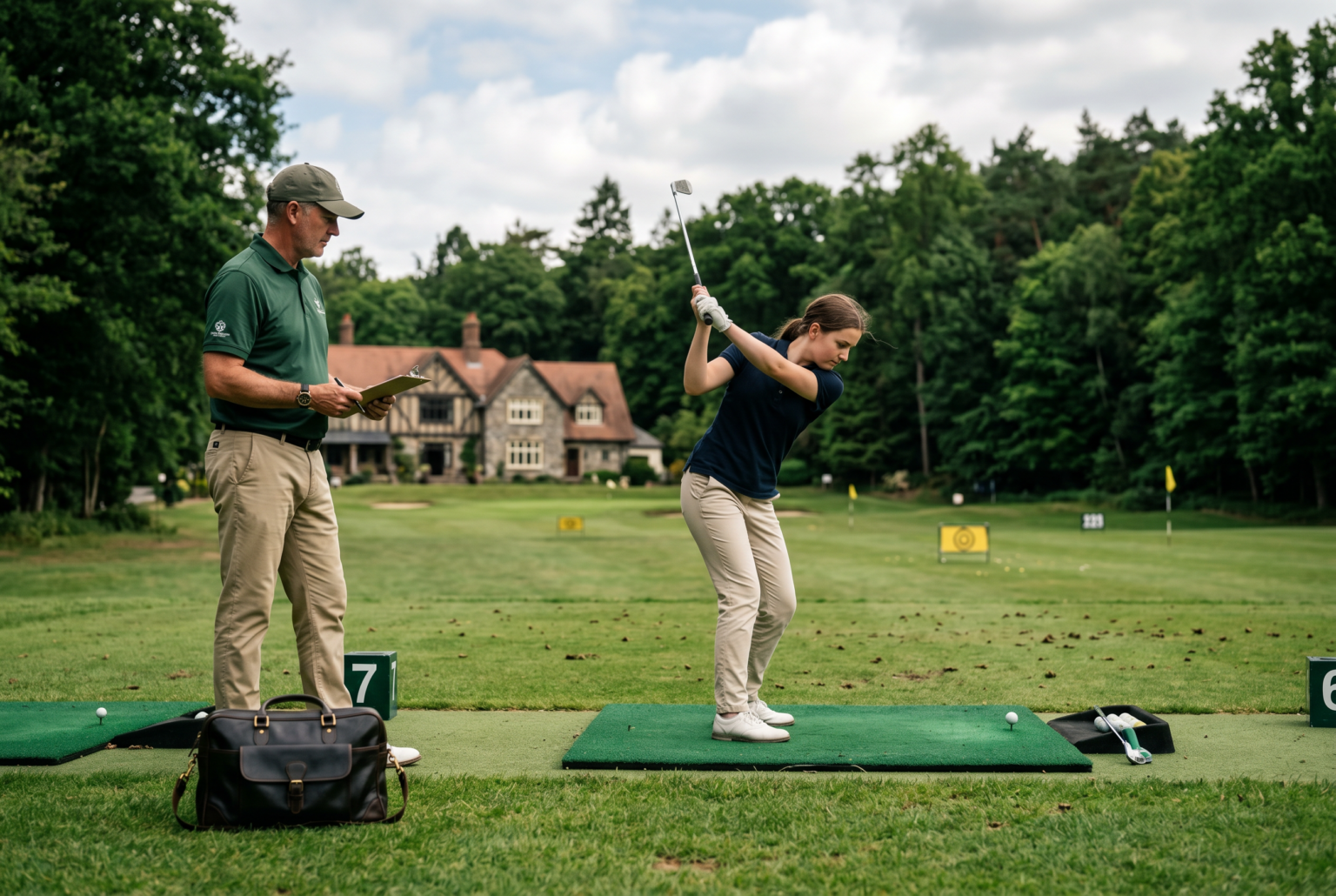
The best practice feels inevitable.
Stop random hitting. Use targeted reps that transfer to your next round.
Deliberate practice vs volume: the beginner trap

Genuine improvement comes from targeted, feedback-rich work—not simply the number of balls you hit. Deliberate practice means identifying a clear skill target, choosing drills that stress that target, and measuring progress with honest feedback. Beginners often fall into the trap of volume: more balls on the range, but without a meaningful signal of what to improve. When you practise, you should feel a sense of moving the needle on specific aspects of ball striking, contact, or distance control. Short, focused sessions beat long, aimless sessions every time.
Designing a 45-minute practice session
A disciplined micro-program helps you avoid drift and wasted time. Here is a reliable 45-minute template you can adapt.
- 0–5 minutes — warm-up and mobility
- Gentle hip rotations, thoracic spine winds, ankle mobility
- 2–3 slow swings with a mid-iron (e.g., 7-iron) to wake the rhythm
- 5–16 minutes — ball-striking focus (iron work)
- Use a mid-iron (7- or 9-iron) with impact tape or a face-marking system
- Work on centre-contact and path; set a target to keep the strike near the sweet spot
- 16–25 minutes — drills for contact consistency by club group
- Irons, wedges, woods each get a focused block
- 25–34 minutes — short-game ladders: 10-yard steps done right
- A ladder that builds distance control and feel
- 34–41 minutes — putting routines that mimic pressure
- A rhythm-based routine with a scoring objective
- 41–45 minutes — review loop and plan for next session
- Brief video check and a single correction to carry forward
Pro Tip. clock accountability matters. Use a timer or watch to ensure you move on at the planned moments, not when you feel comfortable.
Shot quality scoring for beginners
To translate practice into real scores, give each shot a clear, reproducible quality score. A simple scheme works well:
- Contact: 1–5 (1 = toe or heel strike, 5 = solid centre contact)
- Path: 1–5 (1 = heavily over-the-top or inside-out with bad face angle, 5 = neutral or slightly inside-out with square face)
- Face angle at impact: 1–5 (1 = closed/open at impact, 5 = square)
- Distance control: 1–5 (1 = big miscalibration, 5 = right on target)
- Overall quality: 1–5 (a holistic read of the shot)
Record a quick note after each shot (even just “centre contact, slight push") and review over time. The goal is to move the average score upward week by week, not to chase raw distance.
Pro Tip. keep the scoring log compact. A small card or app note per practice can be enough to reveal slow, meaningful trends over a few sessions.
Drills for contact consistency by club group
Consistent contact is the foundation of reliable scoring. Here are practical drills for each club group you’ll typically use on the course.
- Irons (6- to 9-iron)
- Drill: Impact tape accuracy with a gate
- How to do it: place two alignment sticks on the ground parallel to your target line, creating a wide “gate” just in front of the ball. Place impact tape on the face. Hit 10 balls, aiming to contact the tape at the very centre of the face and to pass cleanly through the gate with a stable low swing arc.
- Purpose: locks in a centred strike and a repeatable path.
- Wedges (54–60 degrees)
- Drill: Downward strike with a towel cue
- How to do it: lay a towel just behind the ball to cue a descending strike. Keep your trail elbow close to the body for connection; swing at comfortable tempo, focusing on making contact first with the ball, then the turf. Do 12–15 reps with a 50–70% speed.
- Purpose: reduces scooping, promotes solid contact and clean turf interaction.
- Woods (3-wood / driver)
- Drill: Gate drill with alignment sticks
- How to do it: set two long alignment sticks like a gate just outside the golf ball, on the target line. Swing through the gate without touching either stick. Use impact tape to verify face contact and a shallow, repeatable path. Do 10–12 reps.
- Purpose: fosters a repeatable path and solid contact with longer clubs.
Small note: mix in a couple of “mirror swings” on the side after the main reps to confirm your spine angle and balance.
Short-game ladders: 10-yard steps done right
Ten yards is where you start translating practice into lower scores. The ladder here is designed to force good distance control and precise landing spots.
- Start at 10 yards with your favourite wedge (54–60 degrees). Pick a landing zone about 6–8 feet in front of you. Bag a rep set of 5.
- Move to 15 yards, then 20, and 25 yards, repeating the 5-rep pattern at each distance.
- For every distance, you want the ball to land in the target zone and stop within a 3–5-foot circle. When you miss, note the error (short, long, left, right) and carry it into your next attempt with a slightly smaller swing or different club.
- Club strategy: use a lower-loft wedge for the shorter distances and progress to higher lofts as the target distance increases.
Pro Tip. keep your tempo consistent across distances. A simple cue is to count in 1-2-3 for the swing, with the clubhead arriving at the ball on beat three.
Putting routines that mimic pressure
Pressure-based routines on the green are crucial if you want to convert practice into scoring.
- Pre-put routine
- Align to the line, pick a landing spot a ball-length in front of the hole, take a breath, and rehearse a smooth, repeatable stroke.
- Pressure drill
- From 6, 8, and 10 feet, attempt 4 makes in a row within 60 seconds. If you miss, restart the sequence, but treat it as a fresh chance with a slightly adjusted aim and tempo.
- Distance control focus
- Putt to different target distances (3, 6, 9 feet) using the same tempo. Log which lengths you miss and refine the stroke length needed for each distance.
Pro Tip. keep your shoulders quiet and let the tempo come from your trail leg and hips rather than the wrists. A relaxed, steady stroke is your best friend under real pressure.
Review loop: video, feel, and correction
A constructive feedback loop makes practise deliberately progressive.
- Video check
- Record 15–20 seconds from down the line and face-on after a block of practice. Compare against a prior clip to notice whether your path, face angle, and height at impact improved.
- Feel vs real
- Note how the feeling of a neutral path matches what you see on screen. If the feel doesn’t align with the video, adjust your cue.
- Correction cycle
- Pick one concrete correction per session (for example, “keep right elbow tucked through impact” or “soften grip pressure”). Build a small drill around that cue for the next practice.
How to avoid plateaus and overwork
Plateaus show up when you stop challenging yourself or when you train too hard without feedback. To stay progress-driven:
- Rotate the focus
- Alternate weekly between a short-game emphasis, a distance-control block, and a putting-pressure block.
- Set micro-goals
- Each session should have a clear, measurable target (for instance, “centre-contact improves by one step on the scoring rubric” or “distance from 10 to 12 feet improves by 20% in the ladder”).
- Manage load
- Do not extend practise beyond what your body and mind can sustain. Two quality sessions per week, each 40–60 minutes, is better than daily, scattergun practice.
- Build a maintenance plan
- After a productive block, maintain progress with lighter sessions that reinforce the same cues.
What matters most is that your practice translates to real scoring on the course. Targeted reps, honest feedback, and disciplined review form the backbone of a programme that moves you from random hitting to reliable scoring.
Whats next
Next read: efficient short-game practice for better chipping and pitching outcomes, focused on distance control and landing-zone accuracy.